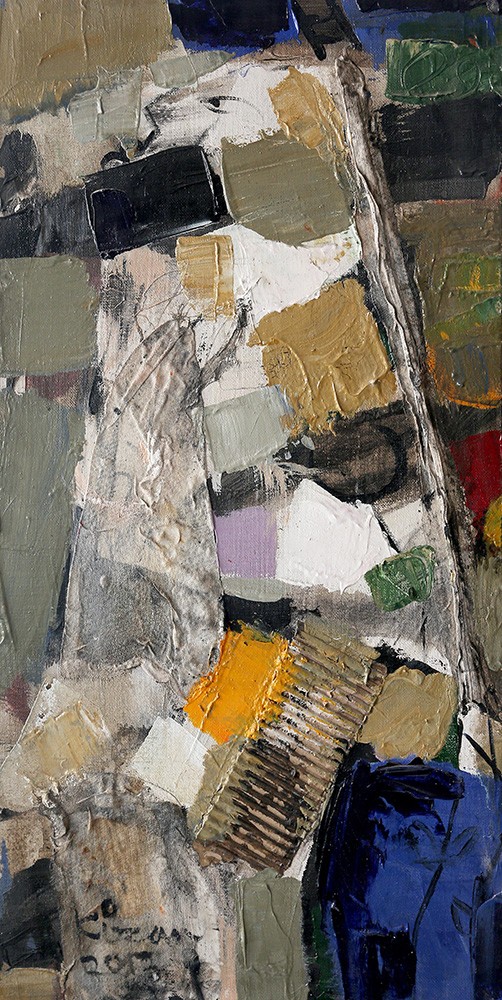
Acrylic on Canvas
24 x 12 in
Nepalese art is often associated with traditional forms like Paubha, Kasthakala (wood carvings), and Murtikala (sculptures). Typically, when we consider artisans, we mostly consider the centuries-old practice they uphold. Nepalese art can also refer to modernist movements like expressionism, impressionism, abstraction, or abstract impressionism, which is something we don’t often consider. Not everyone is familiar with these art forms, and we still link them with the West. Amidst all of this, Kiran Manandhar has established a distinctively nonconformist style while also challenging the whole notion of Nepalese art.
Kiran Manandhar’s artwork, with its non-blended colors and daring brushstrokes, firmly straddles the boundary between tradition and abstract. If you’re used to more conventional forms, his paintings could appear cold and distant at first. On the other hand, we are invited to go into a different domain of art by his cultural motifs and dynamic compositions—one that addresses the soul rather than the eyes. His seemingly scattered forms and patterns are actually quite energetic, representing the harmony and disorder of the universe as we know it. To understand his art, we must feel its rhythm instead of analyzing its meaning. And the next time you see Kiran Manandhar’s work, try asking, “What does it make me feel?” rather than “What does it mean?”